
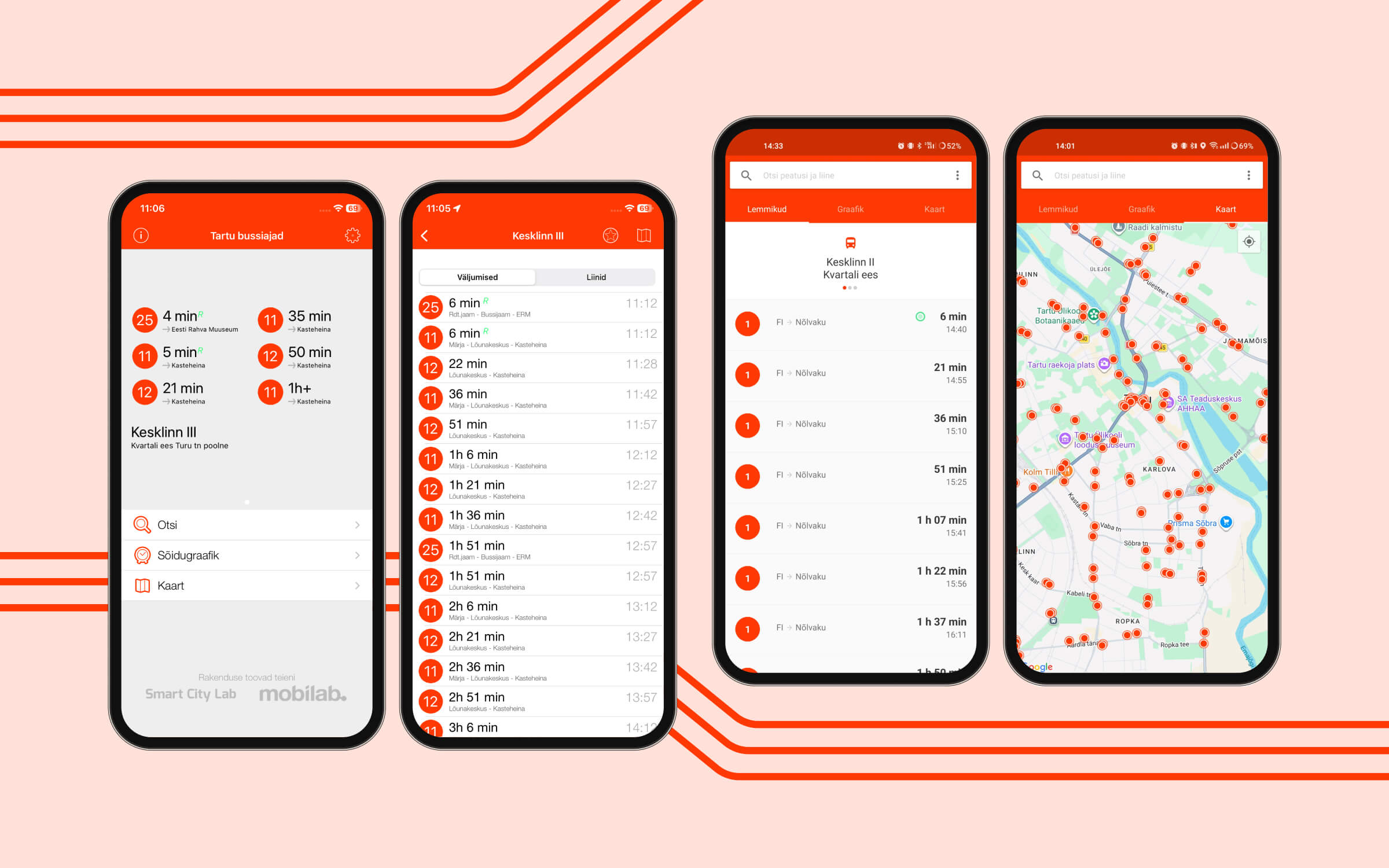
Commuting by bus is a daily part of life for many people and includes small but important decisions, such as which bus stop to go to, which bus to take, whether to hurry, and when to leave home. In Tartu, these decisions are supported by the Tartu bus times app, developed in Mobi Lab to make commuting easier, faster, and more convenient. Users can follow real-time departures, save favourite stops, and navigate routes and bus stops.
Analytics show that the app is widely used in Tartu, but data alone doesn’t explain why people use it or where its real value lies. The question “Why?” became the starting point for our UX research. We wanted to better understand everyday bus commuting experiences by conducting semi-structured interviews. Rather than focusing only on app usage, we wanted to understand commuting routines, behaviours, frustrations, and the emotional experience of using public transportation in Tartu. So we interviewed students and working professionals, as well as daily and occasional commuters.
The research revealed valuable insights:
We realised that the app is more than just a tool for checking bus schedules. It shapes the entire commuting experience, from getting ready in the morning to arriving at your destination.
To understand commuting behaviour, we started with a simple question of why people choose to travel by bus. Tartu is a relatively small city and it’s very easy to travel between districts. Most interviewees preferred walking, cycling, or public transport over driving, even among participants who owned a car.
Bus commuting was described as convenient. It is fast, affordable, and removes the stress of finding parking. In many cases, using a car did not feel necessary because distances in the city are short and daily trips usually take around 15–30 minutes. Some participants noted that a car becomes more useful for longer distances or situations where flexibility is more important. The weather also influenced transport choices. Walking and cycling were preferred in warm weather, while rain and cold made buses or cars a better choice. Several participants also mentioned sustainability as a motivation. Public transport aligned with their personal values and environmental awareness.
The Tartu bus times app plays a role in supporting these choices by making public transport feel easier and more convenient.
We can broadly divide commuting into different types: daily routines, such as going to work or school, and occasional trips, such as going to the store, meeting friends, or attending appointments. We can also divide it based on familiarity: familiar (often routine trips) and unfamiliar trips. These types create different behaviours and information user needs while also affecting how the bus times app is used.
Daily commutes or familiar trips are often built into routines. People know their routes, typical travel time, and when they need to leave home. In these cases, checking bus times is not always necessary, especially when buses arrive frequently. The experience is often more relaxed, and users rely on memory and past experiences.
However, occasional and unfamiliar trips require more planning. Users need to find routes, transfers, and estimate travel times. These situations can also introduce more uncertainty. Planning behaviour also depends on personality. Some participants prefer to plan trips in detail and feel more comfortable when everything is known in advance. Others prefer a more flexible approach and decide on the details while they are already on the move.
When the commute is unfamiliar or time-sensitive, then many users prefer using Google Maps. They appreciated being able to enter a destination and immediately see routes, transfers, and travel times in one place. Some users wished the Bus Times app had a similar feature, while others were comfortable switching between both tools depending on the situation. The difference between the two tools became clear — the Bus Times app supports familiar routines and live departures, while Google Maps is often preferred for unfamiliar journeys.
One of the most interesting findings was how emotional commuting can be. The commuting experience changes depending on specific situations. Stress increases when buses are overcrowded and there is no seating available. Missing a bus and waiting for the next one is another common source of frustration. A few users mentioned constantly opening the app to check departure times to make sure not to miss the bus.
Most users said they are not willing to wait more than 10 minutes at a bus stop. Instead, they often choose alternatives such as walking to their destination or to another stop. This does not necessarily reduce travel time, but users still prefer it because waiting itself feels boring, and time seems to pass more slowly.
At the same time, commuting can also be a pleasant experience. For some people, the bus ride becomes personal time, a moment to read, listen to music, scroll through their phone, or simply pause between activities. Walking to or from the bus stop can also feel calm and refreshing. Public transport is not only about moving from A to B, but also about shaping the emotional rhythm for daily life.
There was a shared understanding among users that buses in Tartu city are often late, and that has been the case for a long time. Because of this, real-time information becomes more valuable than the official timetable. Users rely heavily on live updates before heading to the bus stop, whether they should leave immediately, walk faster, or still have time for a relaxed walk. The app reduces unnecessary waiting and helps users feel more in control over their commute. It provides a sense of predictability in situations that are otherwise uncertain.
Some people prefer the Tartu bus times app over Google Maps even during unfamiliar trips because users trust its departure data more, although research revealed that the app’s navigation for unfamiliar routes and bus stops was less smooth and required going back and forth between screens compared to Google Maps’ feature, where users can simply enter the destination and immediately see route options. This suggests that reliability is valued more than navigation convenience.
Reliance on live data also creates high expectations. When information is incorrect, users quickly become frustrated. Participants mentioned buses disappearing from the list, continuously changing arrival times, differences between departures in real-world and the app, or missing updates due to temporary route changes. These situations can lead to late arrivals or missed connections. Even small inconsistencies can affect trust. In time-sensitive situations, some users switch to alternatives such as cars or taxis, which feel more predictable. Although these issues were relatively rare, they highlight how important reliability is in a transport app. Luckily, these problems did not significantly affect users' perception of the overall usefulness of the app.
This research showed that the app is only one part of a much broader commuting experience. Commuting is shaped by routines, uncertainty, emotions, and small daily decisions. The app does not define this experience, but it helps make it more predictable and manageable. One of the clearest strengths users loved was the simplicity of the Tartu bus times app. With just a single tap, users can see their favourite bus stop and the next departing bus in real time, supporting quick everyday decision-making with minimal effort.
The research also revealed opportunities for improvement, especially around planning journeys and non-regular trips. Trust in the live data remains crucial and the app needs to communicate delays, missing data, and temporary changes transparently.
Ultimately, the research reminded us that designing for public transport is not only about schedules and routes. It is about designing for the everyday experience of moving through the city.