
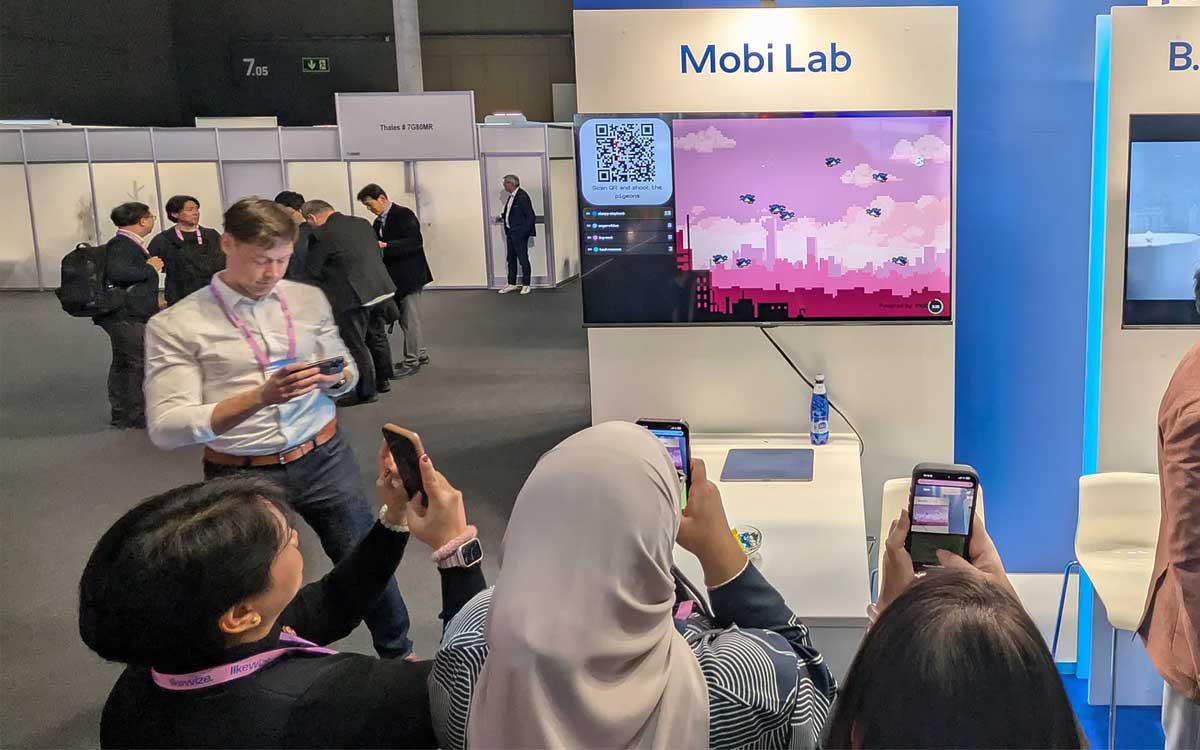
If you’ve ever organised a conference booth or exhibition stand, you know the feeling. You spend weeks on the design, the brief, the visuals. The doors open. And half the people just walk past without stopping.
What makes someone stop? Honestly? Other people stopping.
There’s something almost embarrassingly simple about it. When a small crowd forms around an interactive experience, curiosity does the rest. The challenge is creating that first moment of visible energy. At Mobile World Congress 2026 in Barcelona, one of the world’s biggest tech events, we finally had a proper stress test for our answer: a no-download, phone-based game called WorldPointer that turned any screen into a multiplayer playground.
Over 40 people played it every hour. The crowd genuinely did the marketing.
WorldPointer is an interactive event experience that lets visitors play games on any display using only their phones. Scan a QR code on the screen, point your phone, tap to shoot or collect, compete on a live leaderboard. The entire onboarding takes under five seconds. No app download, no account creation, no waiting.
The phone becomes a physical controller. Players aim it at targets on the big screen, whether that’s ducks, branded products, quiz answers, or anything else that fits the experience. Live scoring keeps the competition alive. And because the leaderboard is visible to everyone walking past, people who weren’t playing thirty seconds ago start looking for the QR code.
This is what booth engagement actually looks like when the technology gets out of the way.
The onboarding is the thing most interactive exhibit technology gets wrong. It asks too much. Download this app. Create an account. Read these instructions. By the time someone has done all that, they’ve already decided it isn’t worth it and moved on.
Event gamification only works if people actually play. That means the barrier to entry has to be nearly zero.
WorldPointer’s onboarding is five seconds. That’s the whole thing. No drop-off, no friction, no moment where a potential lead gives up and walks to the next stand.
The other factor is social visibility. When someone is physically pointing their phone at a screen and laughing, it looks like fun from twenty metres away. Not like a form. Not like a demo. That visible energy is what draws a crowd, and the crowd is what draws more people. At events like MWC, that loop is incredibly powerful.
Exhibition stand designers and builders. Gamified booths see 40% longer dwell time and significantly higher engagement than static displays. Interactive exhibits are 52% more likely to stop foot traffic. WorldPointer is a concrete offering you can bring to your next client, with real numbers behind it, and it doesn’t require rebuilding the stand. It runs on any screen that can show a webpage.
Event organisers. If you’re looking for exhibition engagement ideas that genuinely work rather than just occupying people, WorldPointer fits as an icebreaker, a live competition between attendees, or a brand activation that gives people something to talk about after the event.
Corporate event teams. Company kickoffs, team days, conferences where you want people to actually meet each other rather than drift to their phones. A leaderboard on a big screen changes the room dynamic quickly. It also makes a genuinely good icebreaker because competition is universal.
Retail and public spaces. A window display people can interact with from the street. “Shoot 3 products to unlock 10% off.” Gamified advertising sees 20% higher engagement and interaction times over 60 seconds. That’s not a concept. That’s something we can build.
Museums and learning spaces. Interactive exhibits without shared touchscreens. Visitors use their own devices. No hygiene concerns, no queuing, and the engagement is genuine rather than passive.
MWC is not an easy environment. It’s loud, busy, and everyone there has seen a lot of technology. The bar for impressive is genuinely high.
WorldPointer cut through anyway, because it wasn’t asking people to be impressed. It was asking them to play. Those are very different things. One requires evaluation. The other just requires a free hand and a competitive streak.
The crowds that formed weren’t politely watching a demo. They were competing. Pointing their phones with real focus. Occasionally shouting. That kind of energy is hard to manufacture, and it’s exactly what an exhibition stand needs to justify the floor space.
Over 40 players per hour. At one of the most technologically saturated events on the calendar.
If you’re planning a product launch, trade fair stand, conference activation, or corporate event and you want visitors to actually engage rather than glance and move on, we’d love to show you what WorldPointer looks like in practice.
The demo takes 15 minutes. Scan, point, play. You’ll get it immediately.
Reach out at hello@lab.mobi or visit lab.mobi/services/worldpointer.